|
|
 |
|
| Reviews of Asian Films | |
| 2009: Lost Memories | ||||||||||||||||||||
|
The scope of “2009: Lost Memories” is nowhere clearer defined than in the sweeping epic score that beautifully wraps itself around every scene. This is the score that will greet you in the very first scene of the film. It’s the score that will echo in your ears when leave the film. And it’s the same score that accompany the menu on the DVD. The score underlines the fact that this film is as much an epic action movie, as it’s an emotional drama.
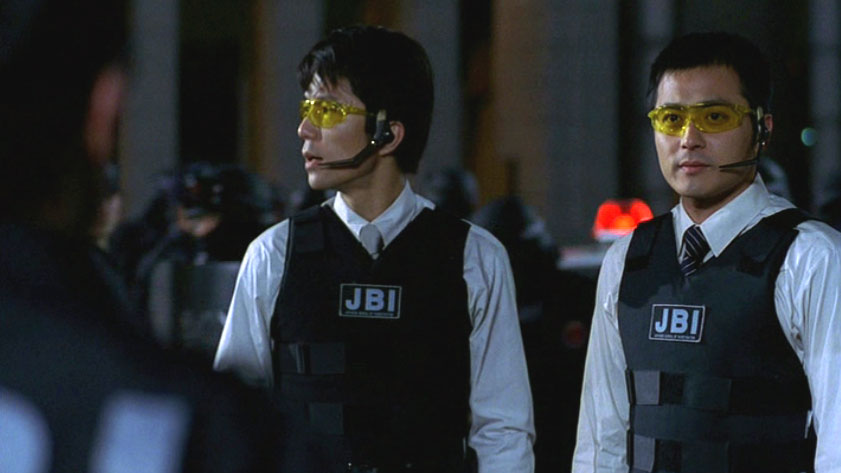
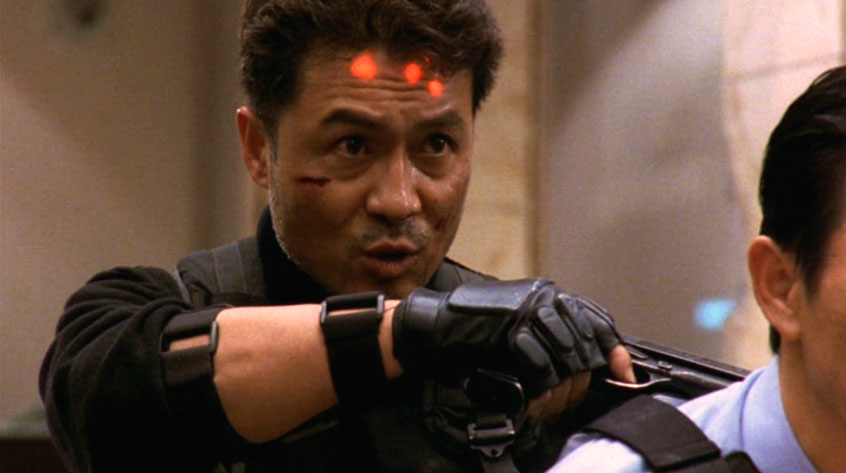
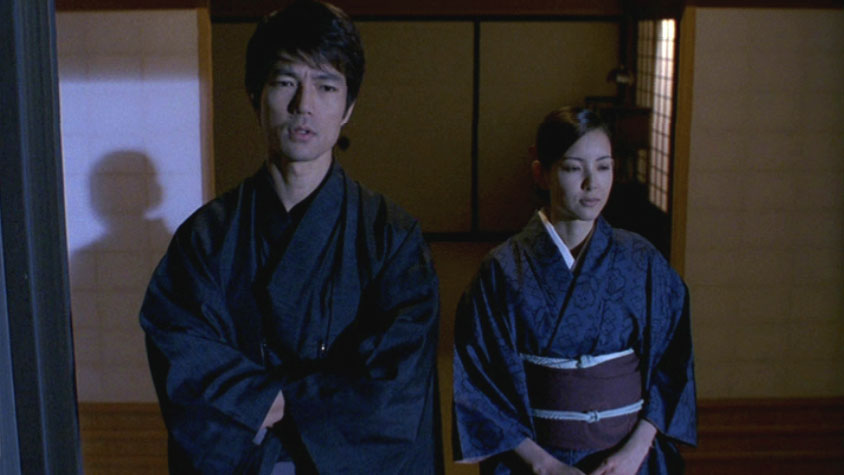
THE STORY The morning of October 26th, 1909. A cheering crowd on Harbin Station in China awaits the arrival of Governor Ito Hirobumi. When he steps off the train a man emerges from the crowd and points a gun directly at Ito. But then he pauses. Out of the corner of his eye the man watches, as one of the soldiers in the honorary formation points his gun directly at him. The soldier shoots, and the man collapses on the pavement. Fast forward through history. Japan becomes the driving force in the Asian region. In 1936 US and Japanese soldiers fight side by side as allies in World War II. 1945. Atomic bombs are dropped on Berlin, bringing the war to an end. 1960. Japan is accepted into UN Security Council as a permanent member. 2009. Present day. Korea is a part of the Japanese empire. The Inoue Foundation hosts an exhibition of cultural artefacts in a beautiful museum. Tranquility is shattered when heavily armed terrorists from the Hureisenjin - a group fighting for Korean independence - attack the exhibition, and take everybody hostage. A massive police operation is mounted. Two agents from JBI (Japanese Bureau of Investigation) arrive at the scene and take charge. Korean born Sakamoto (Jang Dong-gun) and Japanese born Saigo (Nakamura Toru). They enter the museum with a swarm of SWAT soldiers. With no shortage of automatic weapons on either side, the museum soon turns into a battlefield. The Hureisenjin soldiers fight bravely, but to no avail. In the end they are all killed. But to their surprise Sakamoto and Saigo find all the hostages safely locked up in a room, out of harms way. If the Hureisenjin weren’t there to take hostages, what were they after? That seems to be the question of the day, as Sakamoto and Saigo embark on their investigation. When Sakamoto begins to dig into the case, he discovers that several Inoue exhibitions were attacked in a similar manner. He concludes that there’s some sort of connection between the high profile organisation and the terrorists. However, the plot thickens when his superior forbids him to look further into the matter. Saigo pleads for Sakamoto to let the case go, but Sakamoto ignores him and continues to investigate Inoue. His search leads him closer to Hureisenjin, and slowly he begins to question his own identity. Is he Korean or Japanese? And why are these people willing to die for a lost cause? But Sakamoto’s musings are cut short, when an old friend shows up on his doorstep, only to be murdered moments later, by a masked assassin who mistakes him for Sakamoto. Sakamoto has stumbled over a terrible secret. A dark secret that has its origin in the assassination a hundred years ago. A secret that somebody’s willing to kill for. Then Sakamoto is arrested for the murder of his old friend... THE FILM I’ll say this up front. I love these kinds of overblown action films. If you don’t, you might as well stop reading now, because I will spend the remainder of this review praising the wonder that is “2009: Lost Memories”. I’ll call it a masterpiece, say it’s unlike any other film I’ve ever seen. I’ll praise the look, the story, the actors, and mention the look again, just for the hell of it. I’ll cry a little bit, I’ll rejoice, and in between I’ll try to explain why this film means so much to me, why it’s the most exquisite thing Asian action cinema has to offer, and why there’s only one option: to love it. Like I said, if you don’t have the stomach for this, you might as well move on. You have been warned... ABOUT THE STORY When the real Ito Hirobumi stepped off that train in 1909 he really was shot by an assassin. But what if he wasn’t? What if he lived and took part in shaping the next 100 years of Korean history? What if, indeed. “2009: Lost Memories” is built on an intriguing “Twilling Zone” premise, but despite the high concept nature of this idea, it’s not just a clever gimmick. The alternate reality set-up is central to the purpose of the story in ways I cannot reveal here. The film also uses this set-up to play into the ongoing feud between Korea and Japan. I got though my history class on charm, so don’t ask me to explain the sordid past of these countries. For the purpose of the film, all we need to know is that there’s definitely some bad blood between them. “2009” is unlike anything I’ve ever seen before. It’s clearly inspired by large scale American blockbusters, like James Cameron used to make them, but at the same time it retains that distinct Asian feel, with its multilayered characters, and the way it never “dumbs down” the story so everybody can keep up. It’s great to see an action film where it’s not just good guys chasing bad guys, and then everything blows up. “2009” is not afraid to tackle a complicated politically charged story, in the midst of its decidedly mainstream plot. QUALITY IN ACTION “2009” looks like a million bucks. Plain and simple. The cinematography is beautiful and razor-sharp, the sets are gorgeous, and every scene in the movie is tuned to perfection, hitting all the right marks at exactly the right time. The action scenes are painted with broad strokes. Filled with raw unrelenting violence, full of pain. Everyone of these scenes are infused with maximum amount of pathos, especially the ones where we lose important cast members. At times the film is almost unbearably emotional. Yes, it’s another one of those films that brings a tear to my eye. Who says you’re only allowed to cry during chick-flicks, anyway? But then the film shifts to the scenes between the two cops, when they are off duty, and suddenly it becomes subtle and gentle, almost fragile. Hardcore action fans may find these quiet interludes boring, but to me they are absolutely essential. They give the characters a human quality normally unheard of in an action film. The delicate nature of these scenes is in sharp contrast to the violence, but that’s exactly why they work. They let us remember what the characters are fighting for. That an action film - with so much violence - can be so poetic, is truly a wonder. But that’s what makes “2009” such a masterpiece. When it comes to pacing, the film is second to none. It moves swiftly from one set-piece to the next, but never forgets that we still need a moment every now and then to breathe and absorb what we’ve seen. The two most impressive action sequences are cleverly located at the beginning of the film and at the end. The opening attack on the museum, and the finale - where the terrorist stronghold is raided - features my all-time favorite action film component: Hordes of heavily armed SWAT soldiers! Yes! You can never go wrong as long as you have plenty of combat dressed extras waiting to die in a blaze of glory. And what’s the only thing a good death needs? Why, good music of course. Which brings us to the score. From the large scale pompous orchestral and choir tracks that underlines the action scenes, to the simple gentle violin or piano themes that follow each character, every piece of the score perfectly highlights the film’s emotional landscape. The music is the primary driving force in many of the scenes, and I cannot praise composer Lee Dong-June highly enough. He also wrote the stunning score for “Phantom - The Submarine” and “Shiri”. Keep an eye out for this guy. CHARACTERS Sakamoto is a great character. Flawed heroes were always my favorite, and he certainly qualifies. A man torn between two countries, two identities. He’s got no family, the job is all he has. Consequently his commitment cannot be questioned, but he’s reckless and arrogant as hell. His refusal to back down is his undoing, because it ultimately forced his superiors to show their true colors. Jang Dong-Gun is not the most overexposed actor working in Korea today, despite a few high-profile roles. He’s that rare breed of actor equally capable in action and drama, and here he gets a chance to do both. When the truth finally dawns on Sakamoto, and he realizes that everything he knows is wrong, a look of utter disillusion is painted on Jang Dong-Gun’s face. Nothing short of 100% believable. On the other side of the spectrum we have Saigo. He’s a family man, and we often see him with his wife and his daughter. Their connection is obvious. I especially enjoyed the wordless exchanges he has with his wife. She knows that whenever he leaves, he goes to fight for a better world. She doesn’t question him, she just tries to provide him with a safe haven. Even faced with the potentially ultimate sacrifice, she still doesn’t break form. Though she knows he may not return, she just bows gently, and whispers a prayer. This is not a relationship based on decades of male/female suppression, it’s based on a deep understanding of duty and family. The scenes filled me with a sense of desolation and loss. And I loved it. Action films always seem to be at odds with the inherent paradox of their construct. We watch them for the action, not for the characters. If there’s too much focus on the characters we get bored, but if the characters are ignored, the action is pointless, and then the film doesn’t work anyway. It’s a delicate balance, but “2009” seem to have found the perfect mix. WRAP-UP Leave it to Korea to come up with an intelligent blockbuster that satisfies both the naked lust to see guns and blood, while never failing to have a realistic emotional core, and at the same time wraps the whole thing in a genius story. To me “2009” is a defining moment in Korean cinema and one of the best films ever from this part of the world. Even hard-core fans of “2009” will be hard-pressed to follow my vehement praise of this film, I’ll admit that much. I’ll leave room for the fact that I may be out of my mind, possessed if you will. But I can say this, without fear of contradiction: “2009” is exactly what I’m looking for in a good film. Me. Myself. Just me. You may be looking for something different, but that’s okay. To each his own. I found “2009” to be almost impossible to improve upon. It’s perfectly paced, gorgeous looking and it stayed with me long after the credits were over and done. It was one of those films I was looking forward to re-watching it, even before I was finished with first viewing. “2009” is the quintessential action film, be it Asian or otherwise, and if anybody dares to claim that it’s simply too much for its own good, I’ll just hit them with my favorite quote, from the great James Cameron. When a reporter asked him if he ever considered that “less is more”, he simply said this: “Bullshit! Bigger is better! And too much is never enough.” That’s right James, you can never have too much of a good thing. And to paraphrase myself, “2009” is exactly that... a good thing. |
||||||||||||||||||||
|
David Bjerre
July 26, 2004 |
||||||||||||||||||||
|
GALLERY
|








 |
||||||||||||||||||||
 |
||||||||||||||||||||
|
|
|
||||||||||||||||||