|
|
 |
|
| Reviews of Asian Films | |
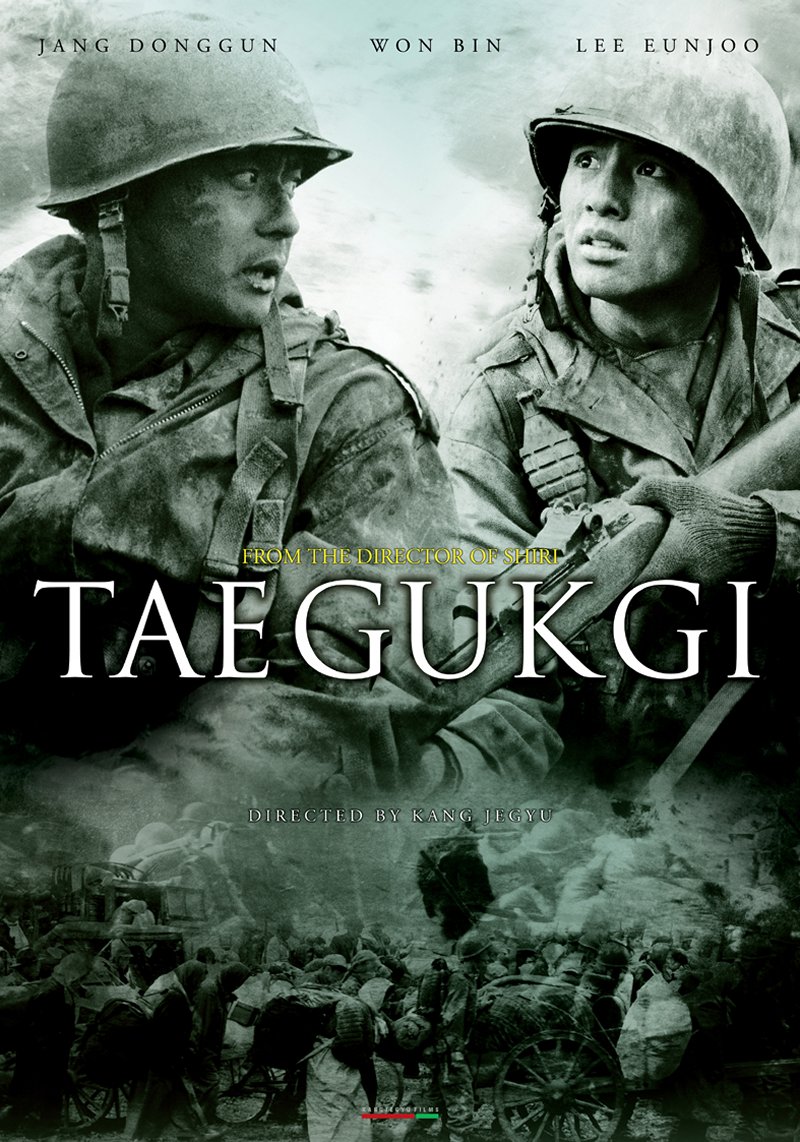
| Taegukgi Aka "Brotherhood" |
||||||||
|
In the beginning of 2004 the South Korean film industry was shaken twice within 2 months. First, “Silmido” broke every imaginable record and pulled 11 million people into the theaters when it opened in December 2003, making it the most watched film ever in Korea. Then in February 2004, “Taegukgi” surpassed that record, by moving almost 12 million tickets. That means a third of the population saw these films. But “Silmido” and “Taegukgi” share more than impressive boxoffice numbers. Both films deal with the relations to North Korea, and both films are - in one way or another - about war.
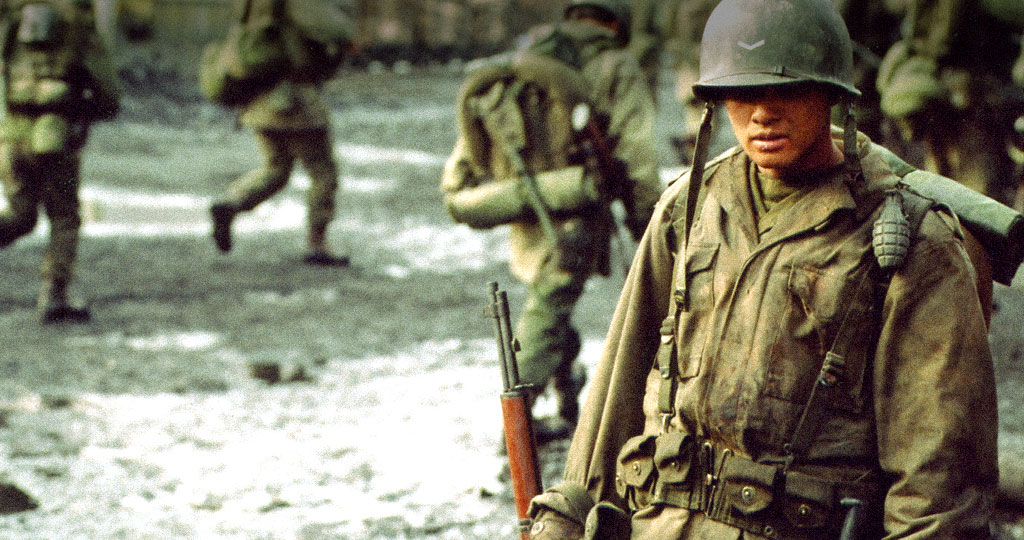
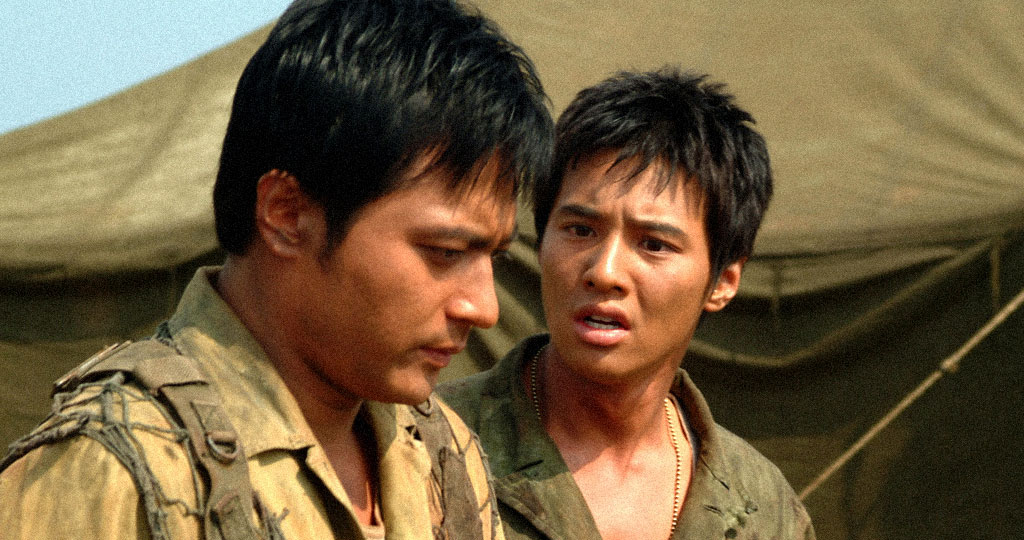
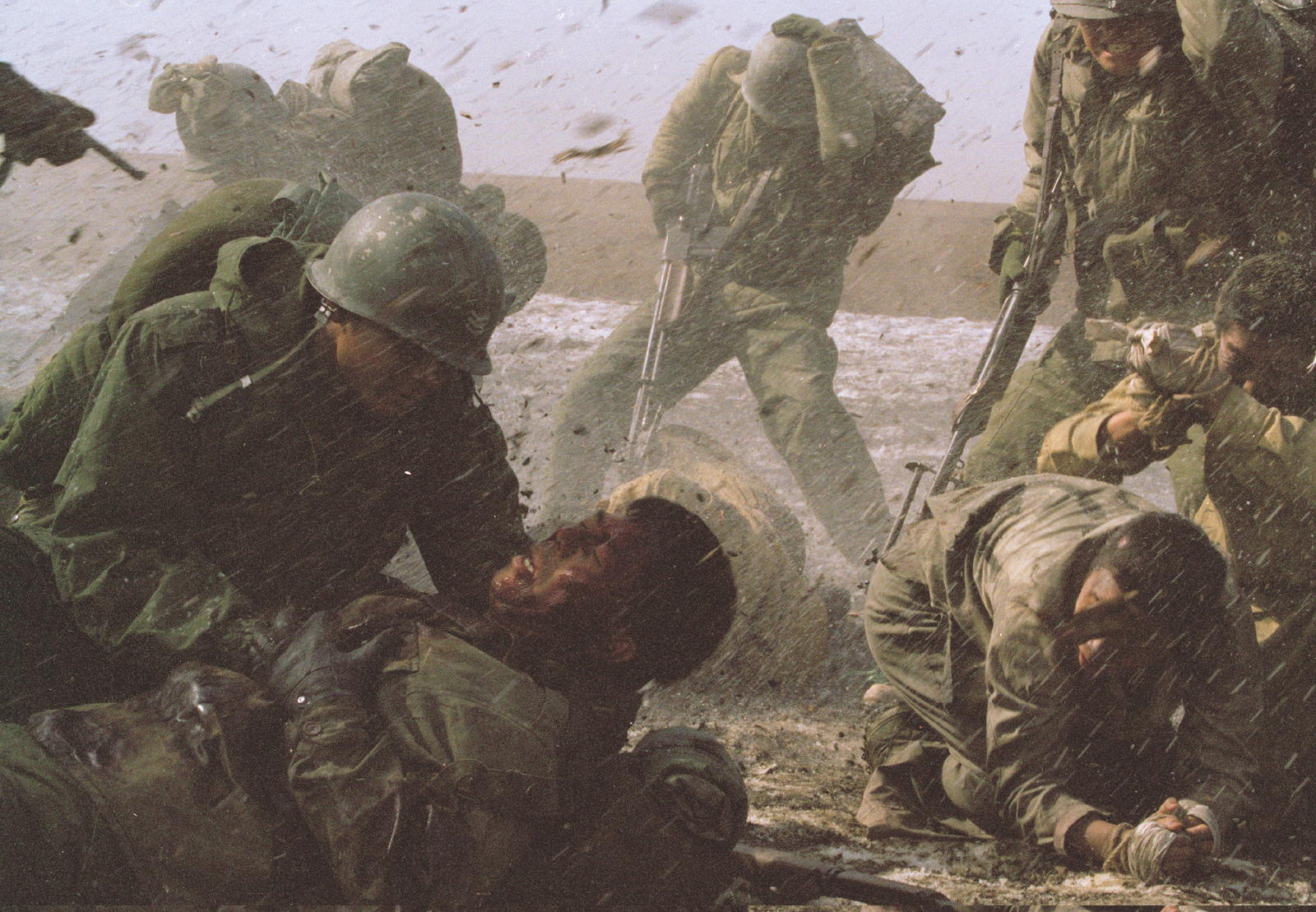
THE STORY A dusty skull is slowly uncovered as a brush carefully exposes the remains of a skeleton. The skull lies next to a bullet riddled soldier’s helmet. We’re at an excavation. A memorial site for the Korean war is under development. Archaeologists are working, trying to identity the scattered remains of the brave men who once fought on these fields, and made the ultimate sacrifice for their country. Elsewhere an old man, Lee Jin-Seok, receives a phone call from the army. They’ve found a body that they suspect is his, and they’re calling to confirm that he is, in fact, still alive. This blast from the past brings about old memories. Jin-Seok picks up an old photo and thinks back... Seoul 1950. Jin-Seok (Won Bin) and his older brother Jin-Tae (Jang Dong-gun) run though the streets of their hometown, without a care in the world. They have everything they need. Clothes on their backs, food on the table, and a loving family. The brothers live with their mother, their much younger siblings, and Jin-Tae’s soon-to-be wife Young-Shin (Lee Eun-Joo). This tranquil existence is shattered when war breaks out. North Korea has invaded, and the family is forced to abandon their home, as it is on the verge of the border. While the family is making its way to safer grounds, soldiers arrive and take Jin-Seok into custody. All men capable of carrying arms must report for duty, whether they like it or not. Jin-Tae try to free his brother, but he too is captured, and both of the brothers suddenly find themselves on an army train, heading straight to war. Cut to a brutal battlefield. Scared inexperienced young men move through the crude trenches, with explosions going off everywhere. It rains bullets and everything is soaked in mud. Jin-Seok and Jin-Tae manage to stay alive through the first harrowing battles, and eventually they find themselves in a small tight-knit group of soldiers. After a long siege, the men are starting to go crazy. There’s no water, no food, and they are slowly dying. As a last resort Jin-Tae suggests that they attack, instead of just defending. An unprecedented move that is sure to surprise the North soldiers. With new-found vigour, the starving men attack the other side. The attack is a success, earning Jin-Tae the respect of the men and his superiors. Jin-Seok, on the other hand, grows increasingly frustrated with his brother. Jin-Tae volunteers for every mission, the more suicidal the better, in an effort to earn a Medal of Honor. Such a medal will enable him to request that his brother be send home. The pursuit of this medal bec0omes the only thing on his mind. Soon Jin-Seok can’t even recognise his own flesh and blood any more. The war drives a wedge between the brothers. As the world crumbles around them, so does the relationship they used to have. War changes people, but some more than others. Will these two brothers ever be able move past their differences and reconcile? Will they even make it home in one piece? And will this useless war ever end...? THE FILM “Taegukgi” is a huge movie. No, I mean HUGE! It surpasses “2009: Lost Memories” and even “Silmido” in terms of scope and grandeur. In fact, it is possibly the biggest South Korean film ever. This is the stuff that blockbusters are made of, but “Taegukgi” is also surprisingly emotional. A film that expects and demands tears from even the most stone cold viewer, and stops at nothing to achieve this. As the most anticipated Korean film in a long time, “Taegukgi” certainly has its work cut out for it. Does it succeed? Is it worthy of all these expectation? Well, yes and no. “Taegukgi” is by no means perfect. There’s a lot of things that could be criticised about the film, but then again, except for a handful of absolute masterpieces, all films have flaws. I guess it’s just a matter of how much those flaws mean to you, how much you can forgive, and - on the bottom line - what it is you’re looking for in a film. One thing is certain, in terms of sheer emotional impact, the film matched my high expectations, and on more than one occasion, surpassed them. “Taegukgi” will inevitably be compared to “Saving Private Ryan”. This is mainly because the shaking camera technique used in the combat scenes, one of the elements that also made Spielberg’s epic so memorable. Both films are war films, both feature guns, blood, gore and loads of mud, and both films share some similar scenes, mainly due to their wartime setting. But despite their similarities, these movies are also very different on many points. “Ryan” often takes a more objective look at the horrors of war. The violence strikes suddenly and indiscriminately, picking out its victims at random. “Taegukgi” is more emotionally invested in its characters. The random acts of violence are certainly there, but in a way the violence seems more sinister here. This is perhaps because the most heinous acts can the contributed to “our guys” and not the enemy. But don’t think this is just wall-to-wall action. There are some brief tender moments between Jin-Tae and Young-Shin, and there’s also a heartbreaking farewell as the brothers leave their family behind. These scenes provide the film with an emotional core very early in the story. Even though we don’t see the family again for a long time, they stay with us because of these scenes. HISTORY OR JUST STORY It’s odd that the filmmakers have chosen such a poignant period in Korean history, and then focused almost exclusively on the fictional characters and events, leaving the authentic drama to serve merely as a backdrop In a way this reminds me of “Titanic”, which also simplified its historic setting, in favour of its fictional foreground story. That has a tendency to cheapen the film, and lessen the impact (I though that was “Titanic’s” biggest problem), and if it gets really critical, it’s borderline offensive. “Taegukgi” never gets into that much trouble. It’s still a very brutal look at war, and the story about the two brothers is supercharged with emotions, so I found it easy to forgive the screenwriters’ choices in this matter. But I will admit that anyone with Korean blood in their veins may feel differently. CHARACTERS AND CAST The bulk of the film deals with either one of the two brothers, or both of them, so actors Won Bin and Jang Dong-gun have a heavy burden to carry. I had been looking forward to “Taegukgi” for a long time, mainly because Dong-gun plays one of the leads. He was fantastic in “2009”, but here he’s very restrained (at least until the end), not the bravura performance I had hoped for, but a solid one at any rate. Won Bin has more to work with as Jin-Seok. His character is the one who has to go through most changes, and he ended up being the one who impressed me the most. When it comes to the supporting players, “Taegukgi” fails to properly establish their individuality. We never really get to know the other soldiers from the brothers’ unit, and when they die it’s not nearly as effective as it could have been. One of the greatest films ever, when it comes to introducing a large cast of supporting characters, is “Aliens”. The film brings a dozen new faces into the story, but within 10 minutes we know exactly who everybody is, what their names are, and what they are all about. I wish every filmmaker who had to deal with a large homogeneous cast watched “Aliens” first, but obviously that’s not the case. PACING The pacing of “Taegukgi” is also slightly off. At times the film feels somewhat disjointed, mainly because if shifts a little too abruptly from one scene to the next, which could indicate that these sequences have been trimmed down. But then, towards the end, the film suddenly gets a little long winded, and it also suffers from the well known “multiple-ending-syndrome” (also known as “Return-of-the-King-syndrome”). Clocking in at close to 140 minutes, the film is too long. Since it’s light on historic involvement, and because it’s basically just a story about two brothers, it could easily have been cut down to about two hours. A decent running time for such a film. COMBAT The battle scenes look gorgeous. One scene takes place at night on a battlefield, illuminated by hundreds of fire pools caused by molotov cocktails. In another scene the soldiers walk through a snow-covered landscape. Sometimes it rains, sometimes the sun shines from a spotless sky. The ever-changing scenery keeps the images fresh, so they don’t lose their impact, as opposed to “Saving Private Ryan”, which just seems to take place in one mud-covered ruin after another. Every action scene in the movie is shot with a special style of shaking camera movements. This type of motion is often achieved by mounting a device on the actual camera that shakes the image. It’s a very unique look that takes some getting used to, because most of the time it’s impossible to see what the hell is going on. Except for a brief glimpse of someone or something that seems familiar, everything’s a blur. Obviously this style was chosen to emulate the frustrating sensation experienced during war, but it will most likely have an equally frustrating effect on some members of the audience. I got used to the style pretty quickly, but I doubt that will be the case for the casual viewer. And then there’s the actual violence in the battle scenes. Combat is not pretty and it’s not clean. There’s blood and guts everywhere. Torn limbs. Men crying out in pain, only to disappear moments later, engulfed in the fire and debris of an explosion. Not to mention that when people get shot, they REALLY get shot! The entire body is shaken by the impact of the bullet, and brain matter is sprayed everywhere. If you squint your eyes I swear you can almost see the soul leaving the body. The violence in “Taegukgi” has a raw uncompromising quality that is as ugly as it is beautiful to look at. WRAP-UP Despite its flaws “Taegukgi” is still an incredible sight to behold. It’s a true epic. In my book an epic is a film that paints its picture on a large canvas. It has nothing to do with how much money is spent on the production. “Taegukgi” earns its credentials, not because it’s one of the biggest Korean films ever, but because it paints such an impressive picture of a dark time in history. Even though it neglects the actual conflict that form the base of its story, in favor of the small story about the two brothers, and even though it doesn’t really have a deep message (I mean “war is bad” is so trivial it doesn’t even count), “Taegukgi” still works as an emotional action-oriented drama. I love big films that make me fall in love with their characters, only to slaughter them in the most brutal ways possible. I love the big tragedy, and I love films that send me home with a heavy heart and tears in my eyes. In that way “Taegukgi” succeeds on a remarkable scale. |
||||||||
|
David Bjerre
August 29, 2004 |
||||||||
|
SPECIAL NOTE: I saw this film at the 2nd Copenhagen International Film Festival. It was screened in a 35 mm copy with English subtitles.
|
||||||||
|
GALLERY
|



 |
|||||||||||||||||||||||
 |
|||||||||||||||||||||||
|
|
|
|||||||||||||||||||||